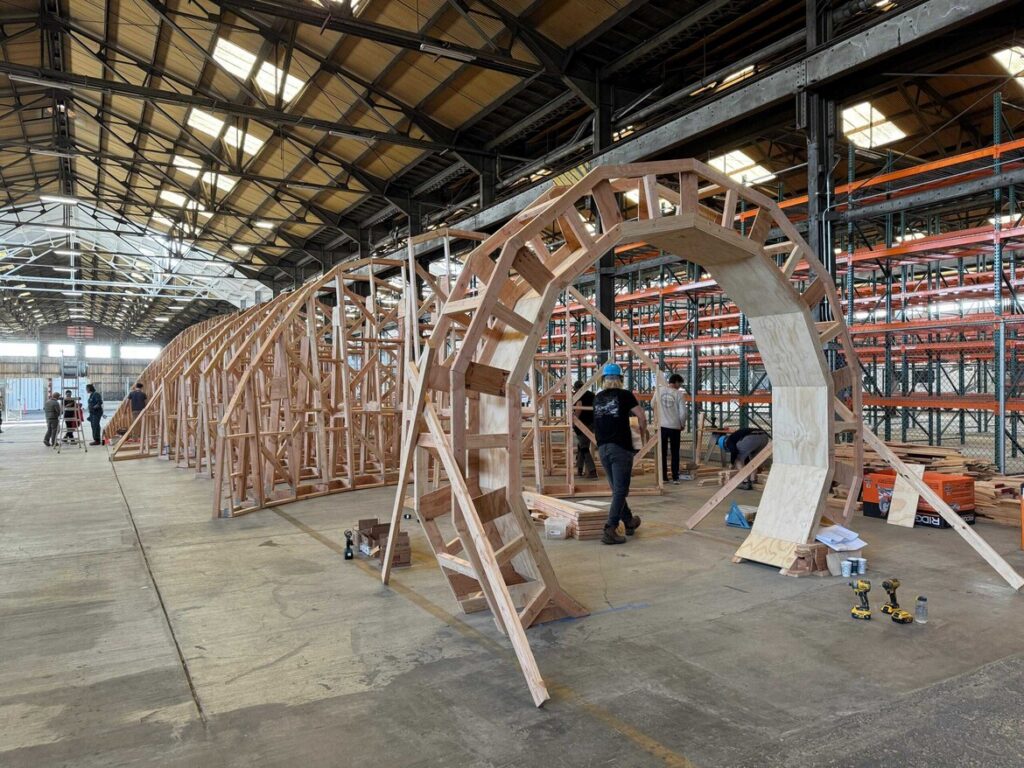
Moon Gate Portals
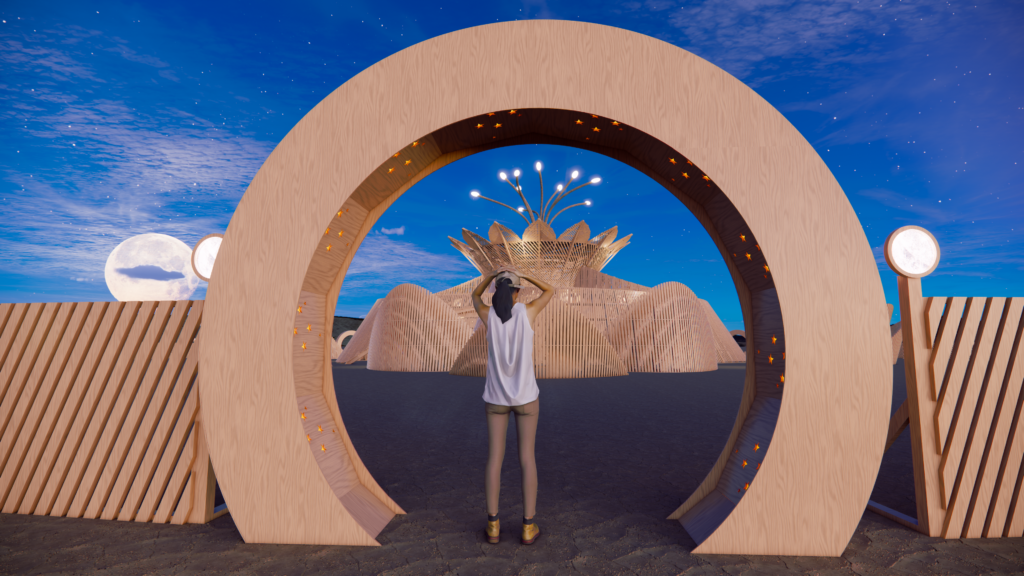
Surrounding the Temple, eight Moon Gates pierce the fence line, each one embodying a different phase of the moon. The interior of each gate features community-designed artwork CNC cut into panels and illuminated from behind. We received more than 20 stunning submissions; read on to discover the eight designs selected through an open community vote — and to celebrate all the beautiful, creative work that was offered.
Chosen Artworks
Below are the eight artworks that will be cut into the Moon Gates and displayed at Burning Man!
New Moon Gate: Dark Forest by Janglemuffin Trapnose

(I went to the dark forest and everyone knew you)
Design depicts naked branched winding tree against a low bright horizon back drop which transitions to a night sky half way up… the tree elements on the lower portion are mostly solid against the negative space of the back light bright background, and transition to being the cut out portions where they are against the solid in fill of the night sky. Spectral rays make a halo around the black disc of the moon, some thin cut out high branches cross in front of the disc. both the crossing branches and the spectral lines can be used to keep the moon disc properly bridged.
The panels are to be mimicked on the opposing side in screw symmetry (as opposed to mirror) so the top branches seem to arc towards each other. Moon will be redacted from the opposing side top panel, with the ray lines extending from the kept moon panel to add continuity and coherence to the design.
This design was inspired by the art nouveau esthetic, and if there is time, I may round border corners or add other border elements in the vein of Alfonse Mucha. each other to show the full bloom of the flower as both the apex of its rise as well as the beginning of its return to rejoin the earth. The moon phases in the background mirror this progression, framing the flower’s life cycle as part of a larger natural rhythm of emergence, fullness, decline, and return. Ashes to ashes, dust to dust. As above, so below.
Waxing Crescent Gate: Half Dome by Emerald Mayo

This design was inspired by the interconnected relationship between earth, growth, cosmos, and memory.
The crystals represent the elemental foundation of the earth itself — ancient structures formed under
pressure and time, something I’ve always felt connected to, especially sharing a name with a gemstone.
From those crystals emerge mushrooms and mycelium, which I believe are some of the most fascinating
organisms on the planet. The hidden communication networks beneath forests feel almost magical —
intelligent, alive, and connective.
The moon has always felt deeply personal to me as both a source of rhythm and reflection, especially as a
woman. The stars represent what we are all made from: remnants of cosmic creation carried into every living
thing.
Finally, the design resolves into Half Dome in Yosemite Valley — one of the most meaningful places in my
life. I spent summers backpacking there with my father, and Yosemite remains one of the most sacred and
transformative landscapes I have ever experienced, second only to the playa itself.
First Quarter Gate: Cereus by Victoria King

This illustration showcases the full bloom cycle of the night-blooming cereus flower, from its beginning as a closed bud to its ending in a similarly closed form, as the flower withers and falls away to return to the soil. Each pair of parallel panels on opposing sides of the moon gate features the flower in similar forms yet at different stages of its life cycle – one showing its rise toward its peak, and the other side showing its wind-down to the end of its life cycle. The two top center panels are exact mirror images of each other to show the full bloom of the flower as both the apex of its rise as well as the beginning of its return to rejoin the earth. The moon phases in the background mirror this progression, framing the flower’s life cycle as part of a larger natural rhythm of emergence, fullness, decline, and return. Ashes to ashes, dust to dust. As above, so below.
Waxing Gibbous Gate: Artemis by Julien Cohen

Sagan said “Exploration is in our nature. We began as wanderers, and we are wanderers still.” This design celebrates humanity’s exquisite drive for exploration and our imperative to touch the unknown. It shows the path NASA’s Artemis II mission took to orbit the Moon and return safely to Earth, with both bodies at their correct relative size and distance. The background stars comprise a halftone-processed crop of the Hubble Ultra Deep Field, until recently our sharpest and most profound view of the universe, and our place within it. I’ve designed these panels to be as beautiful as they are manufacturable and mechanically robust, and I think it’s important to state no AI was used in their creation. The Temple is an extraordinary space that has provided me great solace; it was an honor to work on this project. What we seek in the deep, we seek in ourselves.
(Waxing Gibbous was chosen for this gate because that was the moon phase when the mission left Earth)
Full Moon Gate: Love You by Sarah Robson

The design is inspired by the phrase “love you to the moon and back” shared between myself and someone I met at Burning Man in 2019. After he passed, those words stayed with me and gradually took on a different meaning, becoming a reflection of love, distance, memory, and the invisible connections we continue to carry throughout our lives. The rocket symbolizes movement, searching, and the emotional distances we travel for the people we love, while the moon represents something constant yet distant, a place we project meaning, memory, and longing onto. The constellations across the ceiling panels, including Andromeda, Perseus, Lyra, Cygnus, Pisces, Orion, and Aquila, were chosen for their links to myths of love, separation, sacrifice, and reunion. They are not geographically accurate, but symbolic. During the day they remain subtle within the design, while at night they will illuminate from within to echo the feeling of looking up into the night sky. I wanted the piece to feel playful, reflective, and universally human, capturing the idea that even when people leave our lives physically, love and connection continue beyond what we can fully see or understand.
Waning Gibbous Gate: Pisces by Abigail Neiheisel (Apples)

On the Sunday of Burn Week, August 30th, the playa will experience a waning gibbous moon in the sign of Pisces. This specific lunar phase elicits a deeply reflective, playful, and imaginative connection to the shadow self. Two similar but opposite storyboards depict our hesitancy to connect with this deeper part of ourselves and the patience required to reach it. The images progress from feeling entirely separate, to being enmeshed and lively – showing that it is not until we intentionally reflect within and without that we are free to express our authentic selves. For this design I largely drew inspiration from the story of Aphrodite who escaped Typhon with her son, now safely living together as two fish in the constellation of Pisces. The evening primrose flower, also associated with Aphrodite and Pisces, is seen throughout the design as a portrayal of the shadow self and an ode to Temple’s atmosphere once the sun begins to set.
Third Quarter Gate: Koi by Alisha Coelho

This piece explores the unseen rhythms that connect celestial cycles to living systems. Koi, known to respond to lunar phases in their feeding and spawning patterns, embody a subtle dialogue between water and moonlight. Their movement through the gates suggests a quiet surrender to natural timing—an honoring of cycles beyond human control. The lotus, rooted in darkness and rising to bloom, mirrors the ephemeral flowering of the Queen of the Night—both expressions of beauty that emerge briefly, then fade. Together, these elements create a threshold space where reflection, transformation, and impermanence coexist. The gates invite participants to cross not just a physical boundary, but an emotional one—guided by the same rhythms that move tides, bodies, and memory.
Waning Crescent Gate: Jaguar by Nicolas Herrera Hernandez

The panels are inspired by Mesoamerican traditions and their cosmology. Across many cultures of Central and South America, the jaguar represents the moon, spiritual power, protection, transformation, and fear. Its presence in mythology often symbolizes a being capable of crossing boundaries between the physical and spiritual realms. In Colombian culture, the jaguar crosses celestial planes and its markings carry the eclipse and moon cycles within skin. As a Colombian, I chose this animal to represent the moon cycles and their relation to the temple: it is the guardian animal of the underworld, the night sun, fear, and rebirth, all presented to you as you enter the space. As a storytelling device, I wanted to create a scene of the jaguar’s life and its relationship to the moon, from cub to adult at its peak, all influenced by the moon and its connection to nature. For this illustration, I chose to trace my own hand illustrations to bring a human connection to a machine-built strategy.
Other Submissions
Below are all the other creative submissions that artists in our community created in consideration for this project!
Berber by Sierra Missig

Inspired by Berber folklore, these panels explore the cyclical nature of existence through the moon’s transition from light to shadow. The narrative draws on the traditional Amazigh belief that cataclysm is a vital precursor to rebirth, using the lunar phases to represent a rhythmic purification of the world. By blending ancient geometric motifs with the concept of a shared cosmic memory, the series frames destruction not as an ending, but as a necessary transformation that allows for a new era of consciousness to emerge from the darkness.
Celestial River by Shannon Riley

This piece depicts a continuous “celestial river” flowing across the archway, starting at the Queen of the Night flower. A rhythmic swirl of petals and stars guides the eye upward toward the moon, emphasizing the connection between the flower and the celestial realm. The drifting petals evoke the flower’s fleeting bloom, while the stars capture the wonder and rarity of its nighttime appearance. As visitors enter the temple, the artwork symbolizes the beginning of a journey of connection, both to oneself and to the universe.
Lahontan by Solar Lovesong

The Playa is a dried ocean floor and the Black Rock Desert was once Lake Lahontan, an ancient inland sea. The moon controls the tides. A moon gate on an ancient lake bed should represent the changes that occur to the energy of the Playa as if the moon was pulling the tides.
Even though water is gone from the Playa, the moon still reaches for it. The lower panels represent the lake bed, salt crystals, dried sediment patterns, and the ghost of water. As the panels rise through the arch, the water returns and waves, currents, and marine life emerge from the cutouts. At the top, the moon itself, pulling everything upward. By day it reads as geology becoming ocean. By night, the cutouts glow and the water comes back as light.
Menstrual Cycle by Victoria King

The most intimate and humanly-embodied cycle from which we all were all created, the average menstrual cycle is timed nearly exactly to that of a full lunar cycle. Historical records suggest that before widespread use of artificial light, it was not uncommon for the menstrual cycle to be synchronized with the moon’s phases. Whether scientific or symbolic, the mirrored phases of the human reproductive system and the moon – the new moon and menstruation as periods of rest and inward reflection, contrasted with ovulation and the full moon as phases of vitality and outward energy – have carried deep significance throughout human history. By pairing our own reproductive cycle with the movement of the moon, this design frames our own existence not as an isolated phenomenon, but as part of a larger natural rhythm of emergence, fullness, decline, and return. Ashes to ashes, dust to dust. As above, so below.
Oceans by Sarah Robson

The design is inspired by the relationship between the moon and the ocean, and the way unseen forces constantly shape the world around us. Each panel uses abstract wave and moon-phase forms that gradually evolve across the archway, reflecting the movement of tides influenced by the moon’s gravitational pull. Some patterns feel calm and uniform, while others become stretched, fragmented and turbulent, representing the emotional shifts, rhythms and unpredictability of human experience. The piece is also inspired by the polarity of Black Rock Desert itself, a vast dry landscape that was once a lake bed. To me there’s something beautiful in that contrast, the presence of water still existing within a place that now appears completely absent of it. I wanted the design to feel minimal, atmospheric and reflective, exploring cycles, change and the invisible connections between landscape, emotion and memory.
Once Upon a Moon by Steven Shimizu

Each panel in “Once Upon a Moon” depicts a scene from children’s literature or folklore in which the moon plays a role. Some showcase childlike whimsy, such as the moon as cheese, the Cheshire Cat’s grin, or the man in the moon. Others elicit the mischief and freedom that often only comes with nightfall, such as the scene of the boy and monsters dancing under the moon from “Where the Wild Things Are” or the little ‘a’, ‘b’, and ‘c’ sneaking up the coconut tree under moonlight from “Chika Chika Boom Boom”. And others are quieter, representing stories of parental love and nighttime solitude, such as a father fetching the moon for his daughter from “Papa, Please Get the Moon for Me”, the “Little Prince” alone in space, the lost bat finding her way back home in “Stellaluna”, and the bunny settling into sleep in “Goodnight Moon”. These panels are made for children (and former children) who still feel the magic of the moon, and for parents who have participated in the bedtime storytelling ritual countless times, even if those nights live on only as a memory.
Perspective by Sarah Robson

The design is inspired by the idea that the moon itself never changes, only our view of it does depending on where we stand. Each panel uses the shapes of the 8 different moon phases to create evolving patterns across the archway. Some patterns are structured and uniform, while others become fragmented and irregular, reflecting how perspective, memory and human connection are rarely simple or consistent. The central full moon acts as a moment of clarity amongst the shifting forms around it, while one panel has been intentionally left blank to represent the new moon, absence, reflection and the unseen. I wanted the piece to feel minimal, reflective and human, exploring the idea that understanding is constantly shaped by perspective and that no two people experience the same moment or relationship in exactly the same way.
Sunspotted by Julien Cohen

Our Moon has a fascinating relationship with the Sun. Yes, there is the hardly believable fact that they appear the same size from Earth, a romantic conjunction of heavenly bodies that makes total eclipses possible. But it is the plainer, the everyday easily ignorable relationship that intrigues me. When we look at our Moon, we see the Sun’s light. This design celebrates the Sun’s awesome power as a reflection on this Moon Gate. It depicts a sunspot roughly 10,000 miles wide, imaged in 2020 by the Inouye Solar Telescope, its tendrils trailing from the top of the gate down to the ground. For scale, the Earth would fit into the central two panels. I halftone-processed the photo to achieve this aesthetic mismatch I appreciate, ensure manufacturability by CNC router, and increase robustness on the playa. No AI was used in its creation. I’m honored to submit for this year’s Temple, a space that brought me great solace when I needed it most.
Tides and Threads by Donna Stamps

The primary theme integrates the eternal, gravitational force of the moon exerted on waves with the personal, labor intensive art of Sashiko stitching. The macrocosm of tides is connected with the microcosm of thread. This gate represents that even immense cycles of nature can be bound by individual actions.
Sashiko Interpretation: The term sashiko literally translates to “little stabs”, which poetically aligns with the “little stabs” of consciousness and self reflection required to release ego and embrace gratitude as the lunar cycle completes and resumes.
Tide Interpretation: The receding tide is not an end, but the crucial phase that prepares the beach for the next incoming cycle. Release is necessary for growth.
Theme Wise Connection: Transformation. Sashiko was historically used to repair and strengthen clothing – making it last longer and become a new iteration of itself at every mend. At its heart, Sashiko is about transformation and regeneration.
Integration: After the Full Moon blooms, this gate is where the experience of the Temple is woven into your psyche, strengthening you for the next natural progression.
Trees by Katya Lavrenova

The design explores the tension between life and impermanence through two interconnected trees — one living and full, the other weathered and bare — joined by flowing currents of wind, roots, and moonlight. Inspired by the idea of a sacred threshold, the composition transforms as it moves through the gate: roots become branches, branches dissolve into spirals and stars, and the moon becomes a quiet point of balance between growth and decay. The piece draws from Japanese woodblock aesthetics. As people walk beneath the gate they move symbolically between earth and sky, death and renewal, stillness and motion.
Waxing Crescent by Sarah Dey

The waxing crescent moon is a phase of optimism, curiosity, and willingness to remain open to all that life has to offer. Beyond that, it addresses the bubbly mix of excitement, curiosity, and fear that come at the precipice of change: the sense of weightlessness you feel when in limbo between the life you’ve built and nurtured, and a new future you’re just starting to let yourself imagine. This gate represents that momentary inhale as you teeter between worlds, fearing the unknown, but choosing to jump anyway. It’s the flutter in your chest when you kiss someone you’re falling in love with for the first time, the glimmer of joy when finding a new hobby that just clicks, and the delight at discovering your first real friend in a new city – it’s the slight tug of hope that you feel once you let your mind slip past the doubt and embrace the “what ifs.” These panels symbolize the beauty that follows once we become courageous enough to take the first step, and let ourselves dream about a world in which it all works out – watching the seeds we’ve planted and the wishes we’ve made be swept up with the wind, twirling and evolving towards one another in a completely unpredictable and non-linear, yet somehow congruent path. As the dandelion seeds dance and flutter upwards to meet the twirling cascade of shooting stars, we walk through the archway and embrace this uneasy feeling: When you jump, what if you fall? Well, what if you don’t? After all, what a gift it is to dream.